Thickness is the first spec most buyers latch onto when ordering mylar bags, and it is also the one most often misread. A higher mil number feels like more protection, so it gets treated as a proxy for freshness and shelf life. It is not, quite. Mil measures how thick the laminate is, and thickness governs how tough and stiff the bag feels — but the barrier that actually keeps oxygen, moisture, and light out comes from a specific layer inside the laminate, not from the total thickness. Understanding that split is what lets you spend on the right thing instead of paying for stiffness you do not need or skimping on the layer that matters.
What a mil is, and the layers underneath it
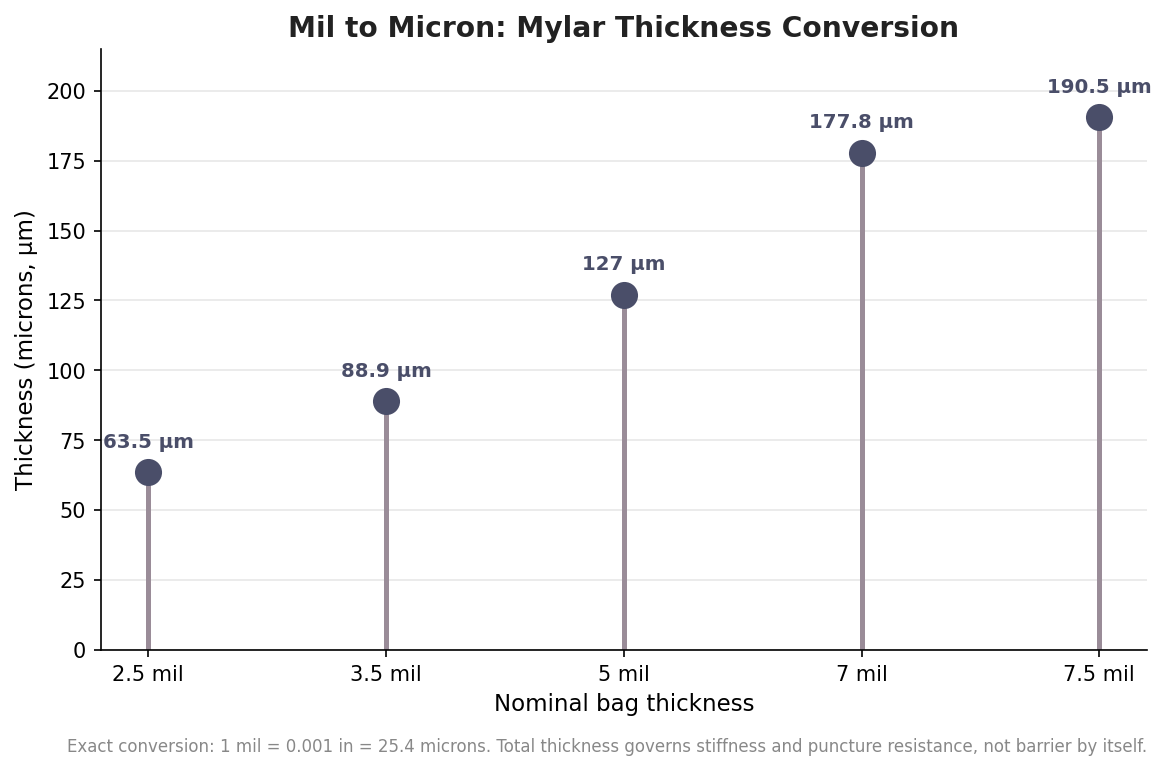
A mil is one-thousandth of an inch, or about 25.4 microns. Custom mylar bags generally run somewhere between roughly 2 and 7.5 mil, so a 5 mil bag is about 127 microns of laminate and a 7 mil bag about 178. That laminate is not a single sheet of mylar. A typical food pouch is a three-layer build: an outer layer of BoPET (biaxially oriented polyester) that provides the print surface and structural strength, a middle barrier layer — either a metallized polyester (VMPET) or a true aluminum foil ply — that blocks light, gas, and moisture, and an inner polyethylene layer that melts under a heat seal to close the bag. Each layer has a distinct job, and only one of them is the barrier.
Thickness is about toughness, not barrier
The single most useful thing to know is that thickness and barrier are largely independent. Adding mil makes a bag stiffer, more puncture-resistant, and more resistant to crushing in shipping, but it does not by itself make the bag more airtight. The oxygen and moisture barrier is set by the metallized or foil layer and the quality of the lamination, and the light barrier depends on whether that middle layer is opaque. This is where a lot of long-term-storage advice quietly hinges on a detail: a thin, translucent metallized bag can let a little light through, while a bag with a genuine aluminum foil ply is effectively lightproof whether it is 5 or 7 mil. So thicker equals better protection is only half right — thicker equals tougher, and the barrier question is a separate one you have to ask directly about the layer structure.
Matching the mil to what goes inside
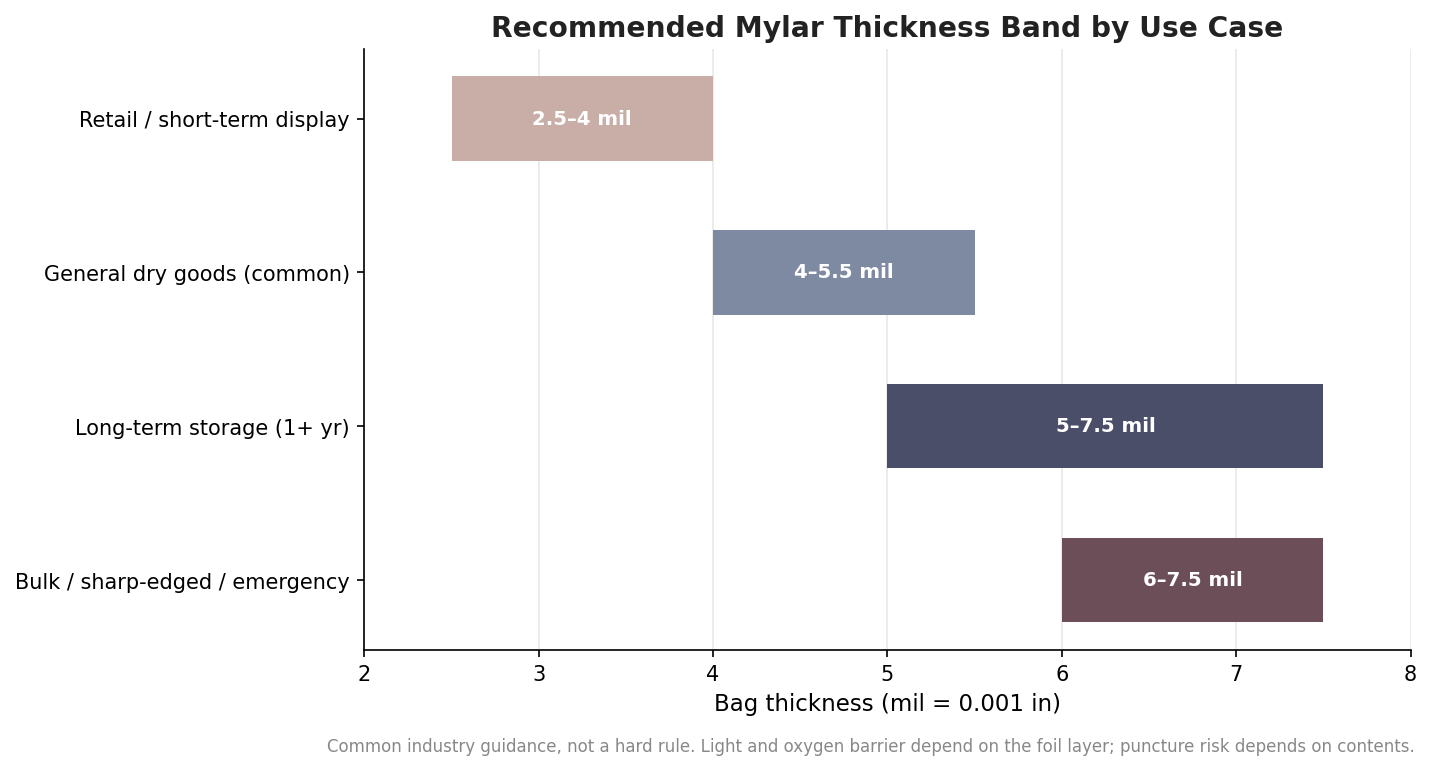
With that separation in mind, thickness becomes a question about the contents and the handling, not the shelf life. For retail products on a shelf for weeks or a few months — snacks, coffee in active rotation, supplements — bags in the roughly 2.5 to 4 mil range are pliable, print well, and cost less, while 5 mil is the common all-round choice that balances durability against price. For anything headed into long-term storage measured in years, the guidance shifts up to about 5 to 7.5 mil, largely because the extra thickness survives stacking, moving, and time without developing pinholes. The other driver is the shape of the contents: soft powders like flour or fine grains sit comfortably at 5 mil, while sharp or hard items — dry pasta, whole grains, anything with edges or points — hold up better at 6 mil and above, where the wall resists puncture from the inside. The bands overlap rather than snapping to single numbers, as the ranges below show.
Shelf life is a system, not a single spec
It is worth being honest that thickness is one lever among several, and often not the decisive one. What actually determines how long dry food keeps in a sealed mylar bag is the combination of a real oxygen and light barrier, a clean and complete heat seal, an appropriately sized oxygen absorber for the volume and residual air, and the moisture content of the food going in. A 7 mil bag with a weak seal or no oxygen absorber will underperform a well-sealed 5 mil bag every time. That is why careful storage guidance pairs thickness with those other steps rather than treating mil as the headline number. When you specify a bag, it is reasonable to ask the supplier not just for the mil but for what the barrier layer actually is, and to confirm the inner sealant suits the sealer you will use.
Specifying thickness on a custom order
On a custom print run, thickness interacts with a couple of other decisions. If you want a clear window so customers can see the product, remember that the window is a spot with no foil barrier — a deliberate trade of some shelf life for shelf appeal, reasonable for fast-moving retail and less so for multi-year storage. Heavier gauges cost more per bag and add shipping weight, so there is no reason to default to 7 mil for a product that will sell within a month. And because thickness does not much change the sealing process, choosing a heavier bag for durability will not complicate your line. A practical way to land the spec is to start from the two questions the thickness actually answers — how rough is the handling, and how sharp are the contents — settle the mil from those, and treat the barrier layer, the seal, and the oxygen absorber as the separate decisions that carry the shelf-life load. The figures here reflect common industry guidance rather than a single standard, and the right number for a given product is best confirmed with a sample.
Leave a Reply