The closure is the part of a mylar pouch a customer touches every single time they use it, and it is also the part most likely to undo the barrier you paid for on the film. A high-mil foil laminate with a poorly chosen top closure can still go stale, leak powder, or fail an opening test. Choosing the closure is therefore a barrier decision as much as a convenience one, and the right answer depends on what is inside, how often the bag gets reopened, and whether the product is regulated.
Every zipper is a hole in your top seal
Start from the trade-off that governs all of it. A plain heat seal with a tear-notch has no interruption running through it, which is why long-term food storage bags pair a simple flat seal with oxygen absorbers rather than a zipper. The moment you add a reclosable track, you add plastic mass and a channel across the top of the bag that the heat seal has to bridge. Manufacturers engineer around this well, but the general rule holds: the more reclosability you specify, the more attention the top seal needs, and the more you should verify barrier performance rather than assume it.
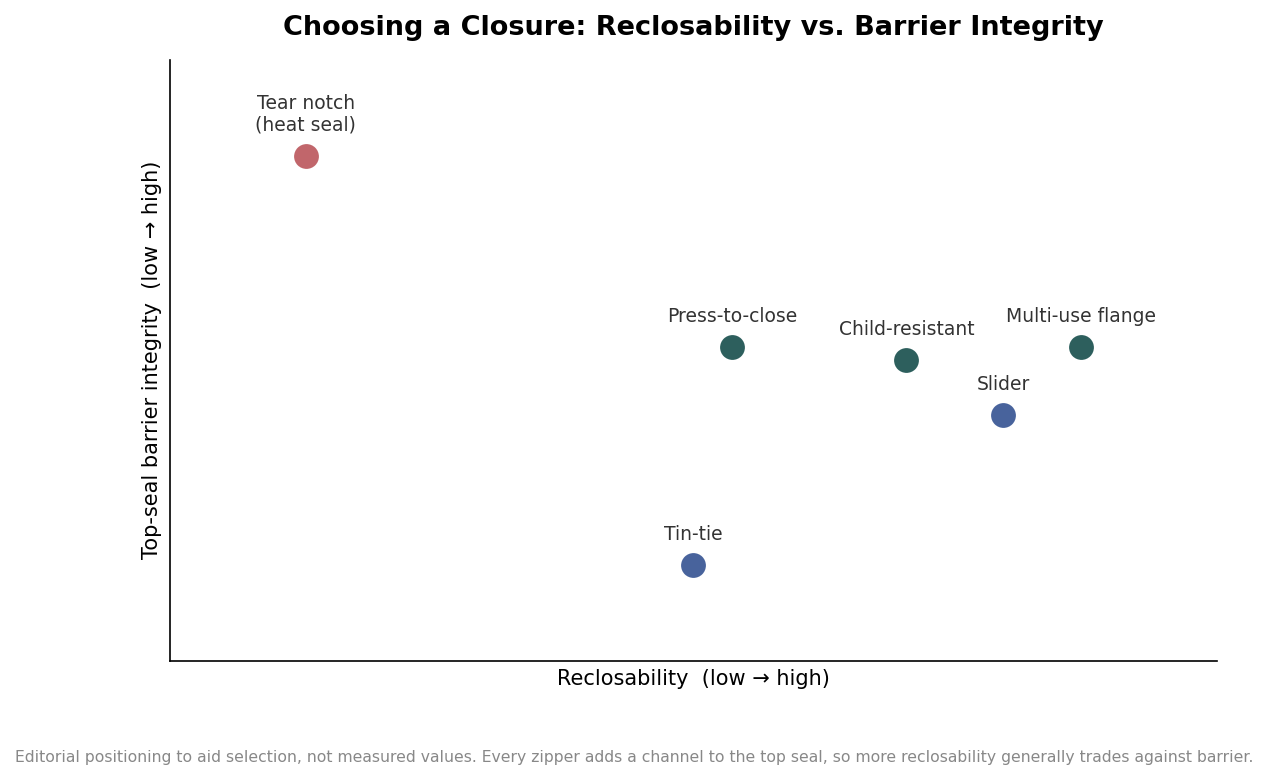
Read that positioning as a guide to the tension, not a scoreboard. A tear-notch sits high on barrier and low on reclosability because it is a one-time opening; a multi-use flange zipper sits high on reclosability because it is built to survive repeated handling. Where your product needs to land on those two axes is the first thing to settle.
Press-to-close and twin-track: the default zippers
The single-track press-to-close zipper is the most common closure on custom pouches, and for good reason. It is economical, it prints and laminates cleanly, and consumers know instinctively how to pinch it shut. Its weakness is human: people tend to seal from the middle outward and leave air gaps at the corners, so it protects freshness only as well as the customer closes it. For spices, seasoning blends, and dry snacks reopened a handful of times, it is usually the sensible default. When the contents are heavier, the bag is large, or there is internal pressure from liquids or a gusset full of coffee, a twin-track profile with two interlocking tracks adds strength and resists being popped open, which is why tamper-evident and larger foil bags often use it. There are also purpose-built variants worth knowing: a powder zipper adds channels that let trapped powder fall back into the bag so the track still seals, and a liquid-tight dual-track zipper is designed to hold viscous contents without weeping.
Sliders: paying for a guaranteed seal
A slider replaces finger dexterity with a guided mechanism. Because the slider forces the two tracks together from one edge to the other, it closes the bag completely instead of relying on the customer to press evenly, which removes the air-gap problem that dogs press-to-close. That reliability is why sliders show up on pet food, protein powders, lawn and garden products, and regulated goods. It is a premium closure, and it earns the premium in perceived quality: research on flexible packaging has found consumers willing to pay meaningfully more for reclosable packaging, on the order of double digits in percentage terms, so the added cost can be defensible on a mid-to-premium product where the closure is part of the experience. Sliders are commonly offered across stand-up pouch widths in roughly the seven-and-a-half to twelve inch range, so they suit most retail formats.
Reclose durability, and why it varies so much
Not all reclosable zippers survive the same number of openings. A standard flange can start to lose grip after as few as ten open-and-close cycles, while a wide-flange multi-use profile is built and tested to survive well over a hundred. That difference is invisible on a spec sheet that just says “resealable,” so if your product is something a customer dips into daily for a month or more, ask specifically about cycle life rather than accepting a generic zipper.
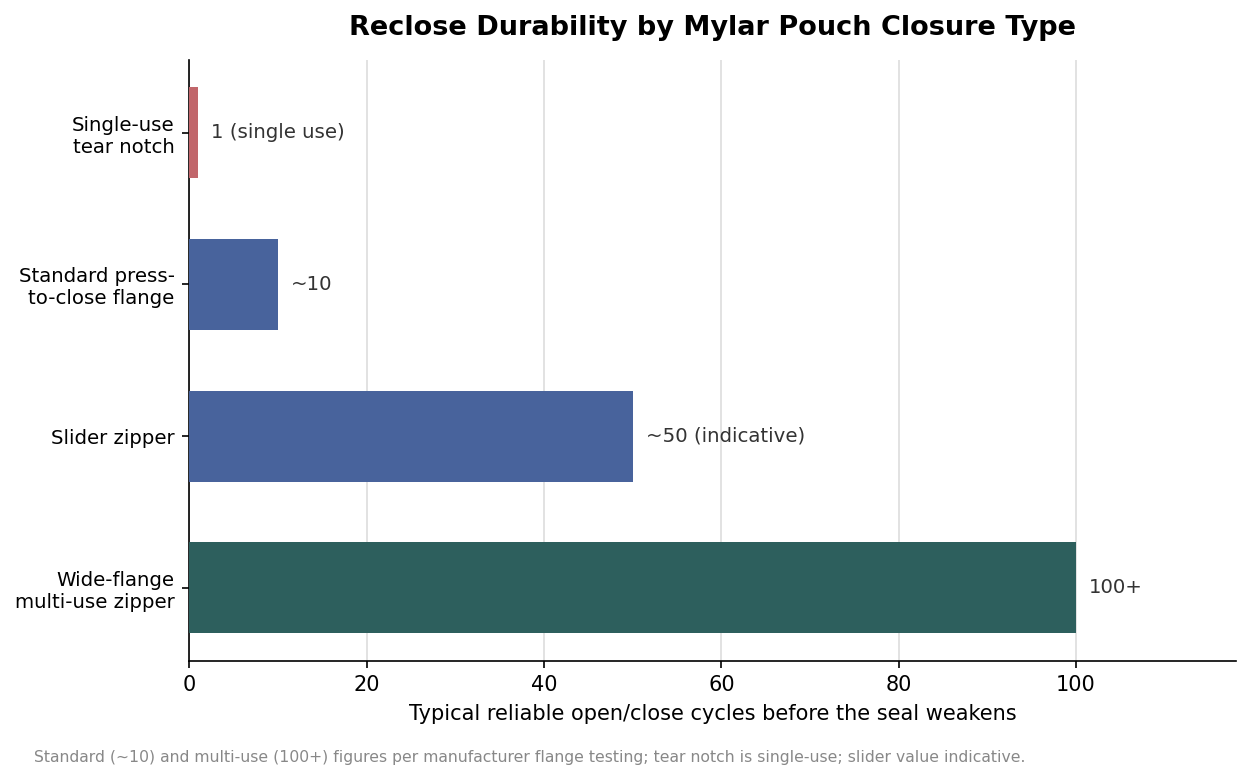
The practical read is that closure choice should track how the product is actually consumed. A single-serving or gift item that gets opened once is poorly served by an expensive multi-use zipper; a bulk pantry staple reopened every day is poorly served by a bargain flange that fails halfway through the bag’s life. Match the cycle rating to the reopening pattern and you avoid paying for durability you will not use or shipping a closure that quits early.
Tear-notches and tin-ties: when a reseal is the wrong goal
Sometimes the best closure is no zipper at all. A tear-notch is a small nick in the seal edge that lets a customer open the bag cleanly by hand, with no reclose function. It is the cheapest option, it preserves the fullest barrier because nothing interrupts the seal, and it is the right call for single-use portions, samples, and anything decanted in one go. The tin-tie, a folding wire strip most associated with coffee, is a different philosophy again: it lets the bag be rolled down and refolded many times but is not airtight, which is actually useful for freshly roasted coffee that needs to off-gas. If freshness after opening is not the priority, or if the product benefits from breathing, a non-airtight closure is a feature rather than a compromise.
Child-resistant closures and the standard behind them
For regulated products, the closure is not a style choice, it is compliance. Child-resistant pouches are tested against a recognized standard, ASTM D3475, and come in several mechanisms including press-to-close variants, latch styles, and sliders with a locking action. They are commonly stocked in sizes such as twelve and a quarter by nine by four inches and can be made to custom dimensions. One point manufacturers are careful about, and buyers should be too: these are called child-resistant, not child-proof, because the standard measures difficulty for young children rather than guaranteeing impossibility. If you sell cannabis, nicotine, or similar regulated goods, the certification is the deciding factor and the aesthetic decisions follow from there. For everything else, work down from the two questions that actually matter, which is how good the barrier needs to be and how often the bag gets reopened, and the closure choice usually makes itself.
Leave a Reply